Work in progress: The project currently reproduces the Learning to Grow experiment, with persistence, regeneration, and original NCA experiments planned next.
The model learns local cell update rules that grow a recognizable lizard from a single living cell.
Learning to grow
The animation shows a rollout from one living cell. Each cell carries 16 channels: four visible RGBA channels and 12 hidden channels. Convolutions provide neighborhood perception, and a stochastic update mask decides which cells update at each step.

Current result
Training backpropagates through repeated NCA steps. In the latest 500-update run, training loss fell from 0.0986 to 0.0107. The model learns the growth process, but it still becomes unstable during very long rollouts.


Rollout metrics
Image error is pixel-wise mean squared error (MSE) over all four RGBA channels of the 40×40 target. I evaluated the stochastic update mask with 20 fixed random seeds.
| Measurement | RGBA MSE |
|---|---|
| Displayed final state at step 64 | 0.02207 |
| Best mean result, at step 80 | 0.01123 ± 0.00074 |
| Step 96 | 0.01951 ± 0.00140 |
| Step 128 | 0.06118 ± 0.00305 |
| Step 256 | 0.60126 ± 0.05772 |
The lowest mean error occurs at step 80. Using a divergence threshold of twice that minimum, with the error remaining above it through step 256, the model crosses the threshold at step 100 and exceeds the original seed’s error at step 149. It learns growth, but not persistence yet.
View the rollout evaluation data ↗
Sobel filter experiment
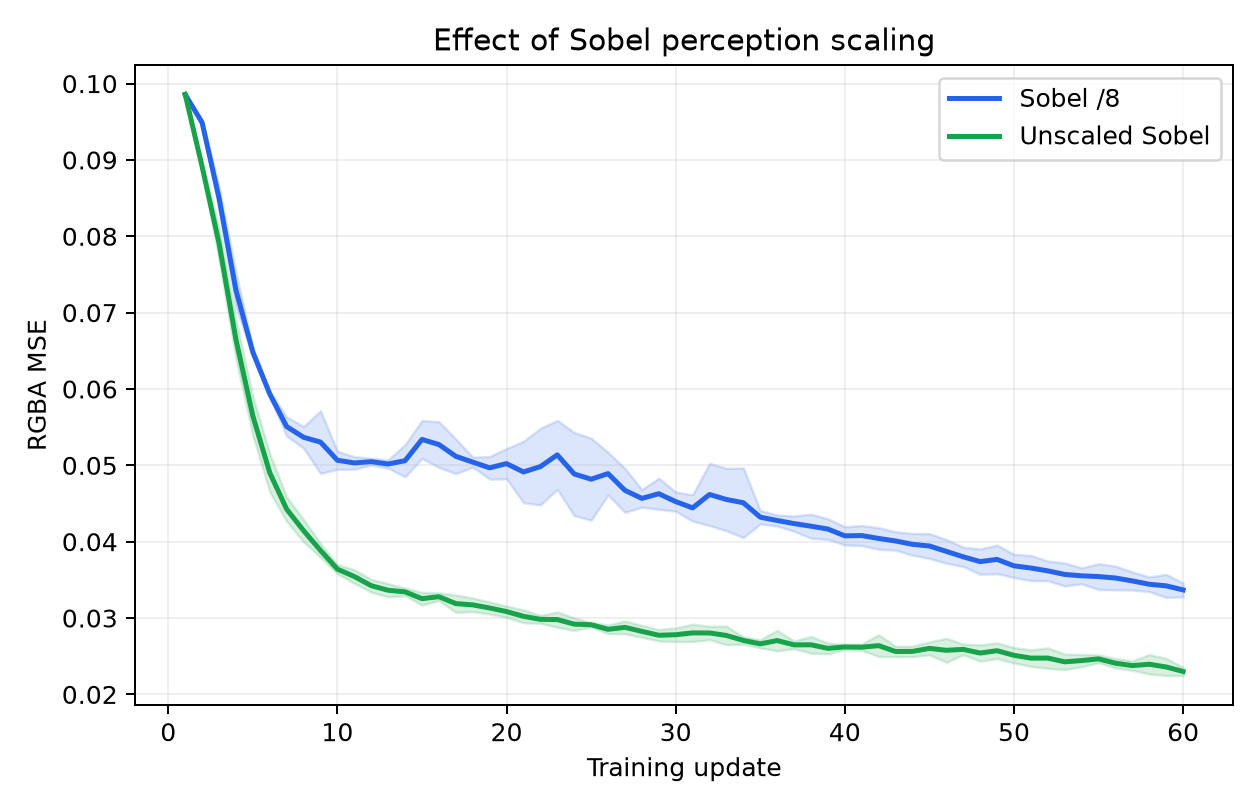
The reference implementation divides its Sobel filters by 8. I compared that version with unscaled filters over five matched training seeds. Each pair used the same initial weights and stochastic masks, with 60 optimizer updates, an 80-step rollout, and a batch size of 8. The lines show the mean and the shaded areas show one standard deviation across seeds.
| Variant | Final-10 mean loss | First update below 0.03 |
|---|---|---|
| Sobel /8 | 0.03518 ± 0.00129 | Not reached |
| Unscaled Sobel | 0.02413 ± 0.00058 | 22 |
In this short experiment, the unscaled filters reduced the final-10 mean loss by 31.4%. This is an early optimization result, not evidence that unscaled Sobel filters are always better.
View the Sobel comparison data ↗
What I learned
- Local update rules can coordinate many cells into a recognizable global structure.
- Hidden cell state gives the system room to carry information beyond visible RGBA values.
- Stochastic updates make the model learn without every cell changing on every step.
- Backpropagation through time trains the same local rule across a full growth rollout.
Next steps
Next I plan to train for persistence, test regeneration after damage, and explore possible evolutionary experiments alongside gradient-based training.